Kanazawa Experience
Why Public Behavior in Japan Is “Naturally Self-Restrained” — The Silent Design Philosophy That “Manners” Can’t Explain
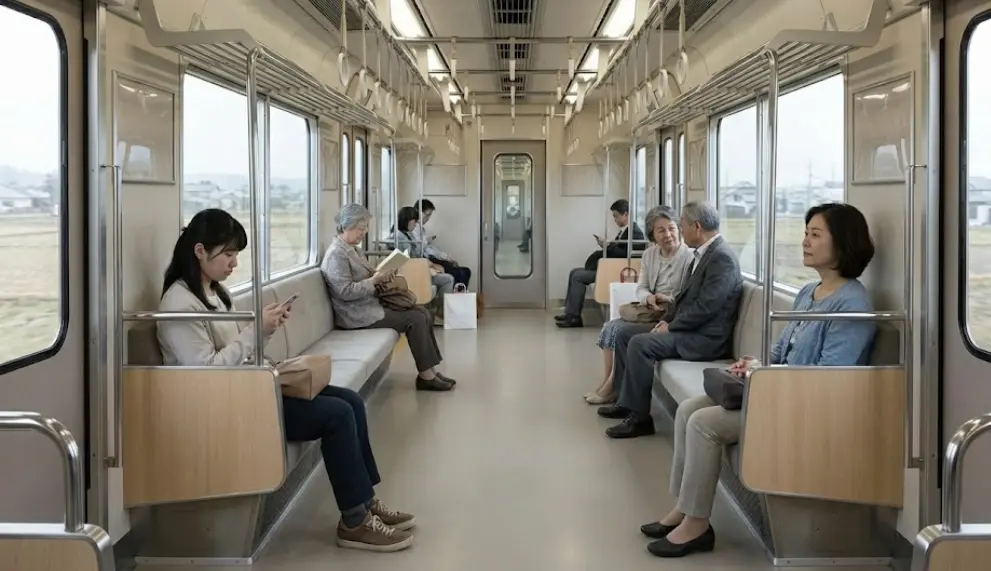
Visitors to Japan almost universally share the same moment of shock.
-
Trains are as quiet as libraries.
-
The streets are spotless, despite almost no trash bins.
-
Lines remain perfectly orderly, even without supervision.
These scenes are often explained away with familiar cultural tropes:
“Japanese people are polite.”
“They have strong manners.”
However, this interpretation is fundamentally incomplete.
Public spaces in Japan are not maintained primarily by manners.
They function because deviant behavior is structurally discouraged before it even occurs.
At the core of this system lies one uncompromising principle:
Do not pollute the public space.
1. Not Polluting the Space with Sound
(Sound as a Shared Resource)
In Japan, silence and atmosphere are treated as collective assets—something everyone present jointly owns.
-
Phone calls are avoided on trains.
-
Sound leakage from headphones is carefully controlled.
-
Voices are naturally kept low.
This is not mere politeness.
There is a widely shared understanding that noise is a form of pollution—an act that deprives others of calm, focus, and emotional safety.
Because of this, restraint emerges without enforcement.
No fines are necessary.
No one needs to be scolded.
The brake is internal, not external.
2. Not Polluting the Visual Field
(Harmony Over Assertion)
Japanese public spaces are strikingly restrained in terms of visual information.
-
Graffiti is rare.
-
Advertisements are tightly regulated in size and color.
-
Unauthorized posters are almost nonexistent.
Here, personal expression does not automatically trump collective comfort.
In Japan, the prevailing assumption is not
“Standing out is freedom,”
but rather
“Not standing out excessively is consideration for the public.”
By limiting visual noise, public spaces reduce psychological fatigue.
The result is calm—not by accident, but by design.
3. Not Bringing Odors into Public Space
(Making One’s Presence Transparent)
Many visitors are surprised by Japan’s sensitivity to smell.
Strongly scented food is avoided on trains.
Heavy perfume is discouraged.
Trash is carried home to prevent lingering odors.
The question is not simply whether something is unpleasant.
It is this:
Does my presence invade another person’s personal space without consent?
In Japanese public spaces, the ideal is to make one’s existence as close to transparent as possible.
Because smell is invisible, it is treated with particular caution.
4. Not Blocking the Flow
(Preserving the Function of Space)
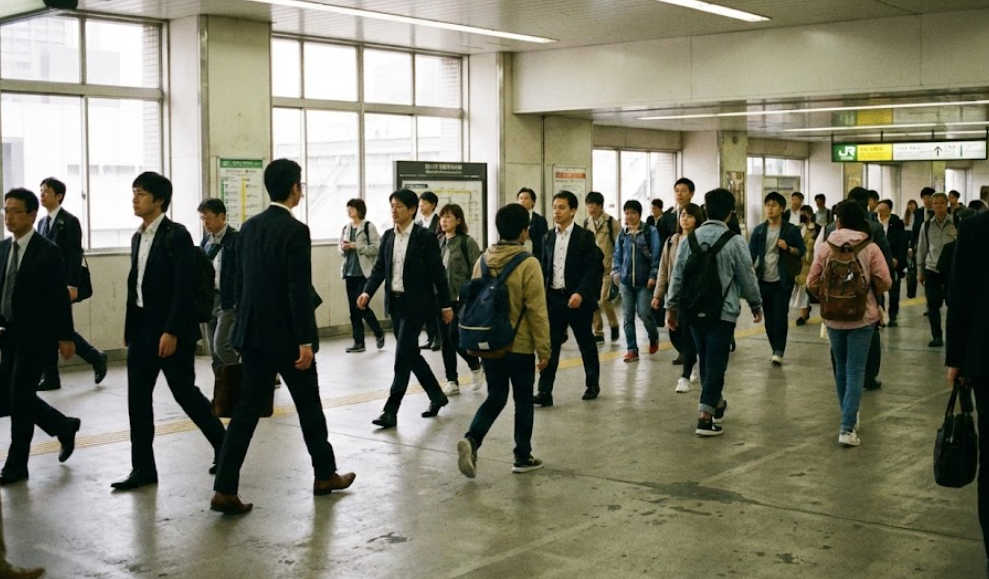
Where to stand on an escalator.
Where not to stop near ticket gates.
How to move through corridors.
Japanese public spaces operate on an unspoken separation between
“static zones” (stopping) and “flow zones” (moving).
People do not stop abruptly in high-traffic areas.
Luggage is not left in walkways.
Movement takes priority over individual convenience.
Blocking the flow is understood as damaging the space itself—
another form of pollution.
5. The Core Principle: Do Not Offload “Processing Costs” onto Others
This is the most critical factor.
Not littering.
Not making noise.
Lining up properly.
All of these behaviors share a single underlying logic:
“If I cut corners here, someone else will have to pay the cost later.”
That “someone” may be a cleaner, a station employee, or security staff.
But it also includes the next anonymous person who uses the space.
Through education, school cleaning routines, and daily experience,
Japanese society trains people to visualize this invisible “next handler.”
As a result, people do not refrain because they are told to.
They refrain because acting otherwise feels unjustifiable.
They don’t think, “I shouldn’t.”
They feel, “I can’t.”
Conclusion: Order Is a Byproduct, Not the Goal
Japan’s cleanliness, quietness, order, and safety
are often attributed to national character.
They are not.
They are byproducts of a system designed around one idea:
Public space is a shared asset,
and its maintenance cost must not be pushed onto others.
It is not that freedom in Japan is restricted.
Rather, freedom is carefully designed so that freedoms rarely collide.
Once this underlying logic becomes visible,
Japan’s streets, trains, and cities appear entirely different.
And this invisible design philosophy—
not morality, not obedience, but spatial design—
is the real reason Japan remains one of the world’s most seamless countries to travel through.