Kanazawa Experience
Why Japan Is Clean Despite So Few Trash Bins — Not a Matter of “Mindset,” but the Result of Environmental Design
Visitors to Japan almost always ask the same question:
“Why is the city so clean when there are hardly any trash bins?”
Many people assume the answer is cultural — that Japanese people are unusually patient, disciplined, or morally strict.
But this explanation only tells part of the story.
In reality, Japan’s cleanliness is supported less by personal virtue and more by an environment that naturally encourages people to take their trash home.
The system shapes behavior first, long before individual awareness comes into play.
The Turning Point: 1995
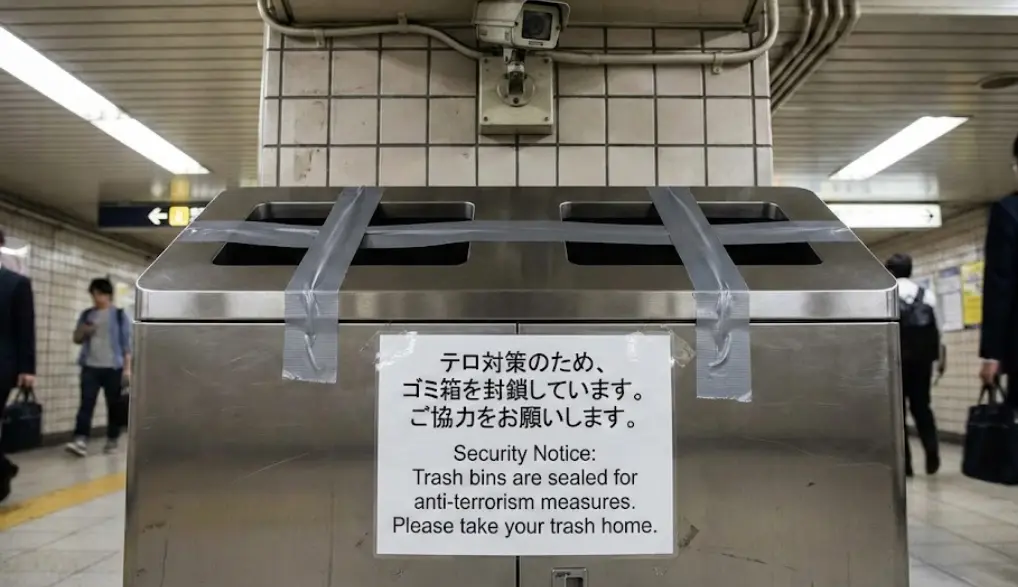
One major moment that shaped today’s system was the 1995 Tokyo subway sarin attack.
After this tragic incident, concerns about public safety and terrorism led to the removal or reduction of many public trash bins in stations and city centers.
Why Did the Public Accept the Inconvenience?
Here, a natural question arises: why didn’t people complain?
Removing trash bins was clearly a reduction in public service. Under normal circumstances, taxpayers would likely be angry.
However, the fear following the attack was intense. The public accepted the removal not as a careless service cut, but as a necessary measure to protect their lives.
The collective desire for safety outweighed the desire for convenience.
Over time, what began as an emergency response quietly became the permanent “new normal.”
How Physical Constraints Changed Behavior
This shift triggered a simple chain reaction in everyday behavior:
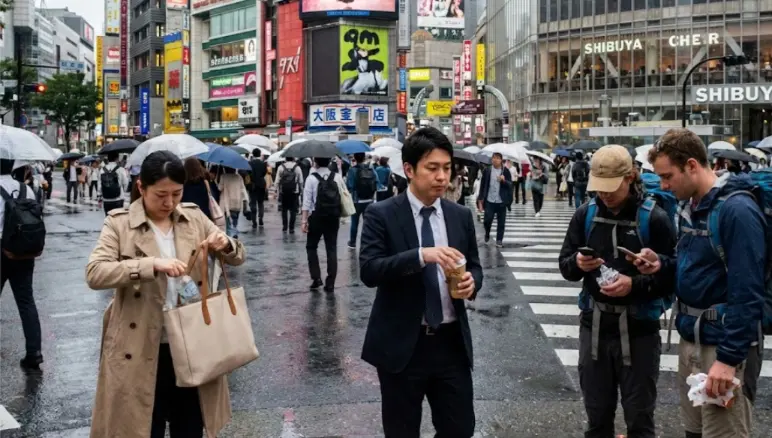
There are very few places to throw trash outside
You leave a convenience store with trash still in your hand
You have no choice but to put it in your bag or pocket
You take it home, or back to your hotel
As this pattern repeated day after day, the idea that “trash is something you take home” gradually became the social norm in Japan.
Inconvenience as Design
Here is the interesting part: even for Japanese people, having fewer trash bins is not convenient.
Carrying an empty coffee cup all the way home is, frankly, annoying.
Yet the streets remain clean because this inconvenience works as behavioral design.
By removing trash bins, the option of “throwing it away outside” largely disappears.
As a result, “taking it home” becomes the default choice — without requiring constant self-control or moral effort.
When I explain this during my tours, many visitors say the same thing:
“At first it was inconvenient, but after a few days, I stopped noticing it.”
They haven’t adopted a new philosophy — their behavior has simply become habitual.
A Society Shaped by Environment, Not Surveillance
Japan is not a society where people constantly watch each other to prevent littering.
Rather, it is a society where the environment itself makes littering unlikely in the first place.
Once people adapt to this environment, the idea of throwing trash on the street rarely even crosses their mind.
Japan’s “clean streets despite few trash bins” are not the result of exceptional morality.
They are the result of history, a collective choice for safety, and environmental design.
Over time, those quiet factors have shaped the everyday landscape visitors see today.