Kanazawa Experience
Where Does the Trash Go?— Why “Taking It Home” Is the Norm in Japan
“If there are no trash bins, shouldn’t littering be inevitable?”
It’s a perfectly natural assumption.
Yet in Japan, the equation works very differently.
Instead of “No bins = inconvenience, so I’ll throw it away somewhere,”
the default response is:
“No bins = I’ll take it home.”
This behavior isn’t exceptional or moralistic.
It is simply normal.
Why does this feel so natural in Japan?
The answer lies less in personal virtue and more in the systems of everyday life.
1. In Japan, You Can See What Happens After You Throw Something Away
In many countries, throwing trash away is the end of the story.
Once it leaves your hand, it disappears from your mind.
In Japan, however, people tend to visualize what comes next—almost automatically.
Someone has to pick it up.
Someone has to collect it.
Someone has to sort it.
Someone has to process or incinerate it.
In other words, discarding trash means creating work for someone else.
Waste disposal is not treated as an invisible black box.
It is understood as human labor that exists directly on the extension of daily life.
That awareness subtly changes behavior.
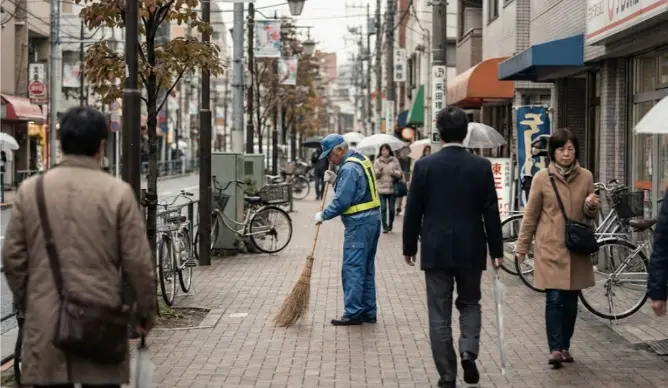
2. Cleaners Are Part of Everyday Life, Not Invisible “Backstage” Staff
Another key factor is visibility.
In Japan, cleaning staff are seen everywhere—
at train stations, shopping streets, parks, and event venues.
They are not hidden away, working only late at night or early in the morning.
They clean in the middle of the day, surrounded by crowds.
This visibility creates a simple but powerful reality:
Trash doesn’t magically disappear. People handle it by hand.
Because of this, littering feels less like breaking an abstract rule
and more like personally burdening someone who is right there.
It’s not about fear of punishment.
It’s about discomfort with imposing unnecessary work on others.
3. Sorting Trash Is “Homework for Your Future Self”
Japan is famous for its detailed garbage separation rules.
Burnables, plastics, PET bottles, cans, glass—often with local variations.
At first glance, this system seems inconvenient.
But it has a strong side effect.
It reinforces the idea that the person who creates trash remains responsible for it until the end.
Trying to throw something away casually outside can be stressful:
Is this the right category? Will it be collected at all?
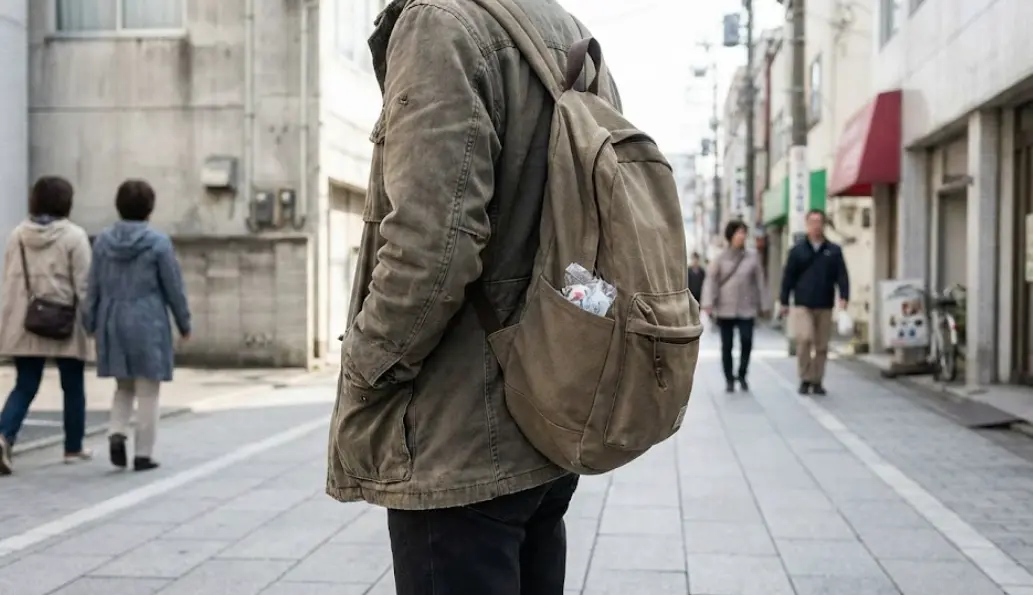
In contrast, taking trash home means dealing with it in a familiar system you already understand.
As a result, “I’ll take it home and sort it properly” often feels like the easiest, least stressful choice.
4. An Environment That Makes Littering Inconvenient—Not Carrying Trash
Public trash bins are rare in Japan.
The reasons vary—security concerns, maintenance costs, sorting issues—but the outcome matters most.
There is no easy path to throw things away.
Searching for a bin is inconvenient.
So people adapt.
They buy only what they can finish.
They don’t expect to discard packaging immediately.
They move through the day assuming trash will stay with them.
Taking trash home is not an act of patience or self-restraint.
It becomes a default part of daily planning.
5. Conclusion: Trash as the Smallest Unit of Responsibility
Here is the most important point.
Most people in Japan who take their trash home do not think they are doing a “good deed,”
nor do they feel morally superior.
They do it because “that’s just how things work,”
or simply because “it’s easier.”
In Japan, trash is not just unwanted matter.
You created it.
You manage it.
You see it through to the end.
Trash is treated as the smallest unit of personal responsibility.
That is why the sequence
Don’t litter → Take it home → Don’t create it in the first place
forms so naturally—and quietly sustains the cleanliness that visitors notice everywhere.