Kanazawa Experience
The Real Reason Japanese Cities Are So Clean — It’s Not Just Manners. It’s the Visible Presence of Cleaners.
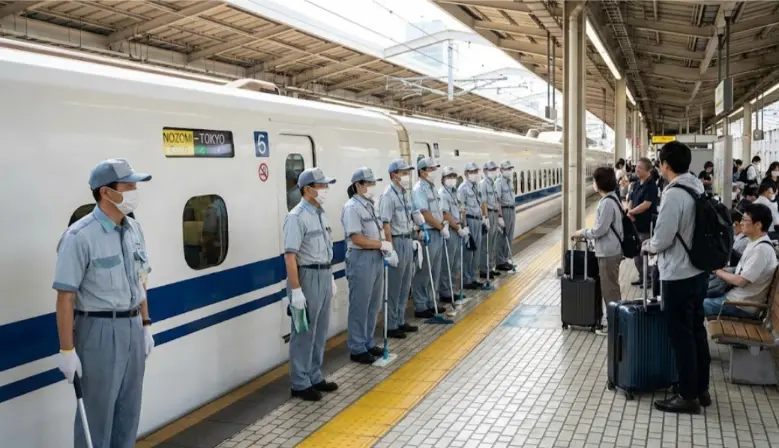
“Why are Japanese cities so clean?”
When travelers ask this question, many Japanese people offer familiar explanations:
“Because of education,” or “Because Japanese people have good manners.”
These answers are not wrong.
But they are not sufficient.
If Japanese people were naturally a population that never litters, then every hidden alleyway and every place beyond public view would be spotless. In reality, that is not the case. Japanese people, like anyone else, are not perfect.
So why do Japanese cities remain so consistently clean?
The decisive reason is not simply that cleaners exist.
It is the way they exist—and how their presence quietly shapes human behavior.
This is not a story about laws, fines, or moral lectures.
It is a story about a highly sophisticated form of social design, embedded in everyday life in Japan.
1. Cleaners Are Not Invisible
In many parts of the world, cleaning work is intentionally invisible.
It takes place early in the morning, late at night, or behind the scenes—out of sight, out of mind.
Japan takes a very different approach.
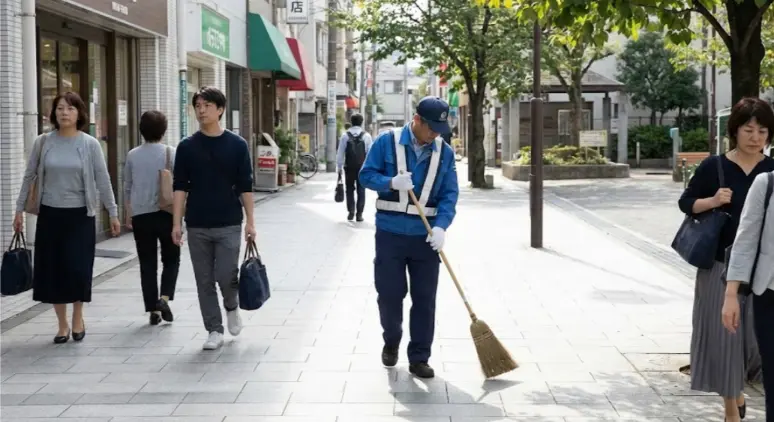
In crowded train stations, department stores, airports, and city streets, cleaning happens openly, in the middle of the day, within the same space used by everyone else.
This difference matters.
In Japan, trash does not appear to disappear by magic. We see brooms moving, handrails being wiped, and floors being polished. We are constantly reminded of one simple fact:
Someone is cleaning this place right now.
This visibility—the visibility of the process itself—is where behavioral change begins.
2. “If I Litter, This Person Has More Work”
Japanese cleaners are not anonymous figures.
They wear crisp uniforms, work carefully, and often greet passersby with a polite “hello” or “excuse me.”
They are unmistakably human.
If cleaning were handled by an invisible system, people might feel little hesitation about leaving trash behind. But when a person is visibly working right in front of you, littering stops being an abstract rule violation.
It becomes personal.
“If I drop this here, that specific person will have to deal with it.”
At that moment, the hand hesitates.
This reaction is not driven by lofty moral ideals or fear of punishment. It is driven by something far more powerful: the discomfort of causing inconvenience to another human being.
That emotion acts as one of the strongest behavioral brakes there is.
3. Public Space Becomes “Someone’s Garden”
An unmanaged vacant lot quickly becomes messy.
A well-tended garden rarely does.
When cleaners regularly patrol public spaces during the day, stations and streets stop feeling like places that belong to no one. They begin to feel like places that are actively cared for.
The meaning of the space changes.
From:
“A public space that no one owns”
To:
“A space that someone is looking after”
The unspoken message is clear:
“This is not a place you can casually damage.”
Through their daily presence, cleaners take on an almost owner-like role, creating a quiet sense of order and accountability within the space.
4. Shinkansen Cleaning as a Ritual
The most symbolic example of this system can be found in the cleaning of the Shinkansen, Japan’s bullet train.
In the brief window between arrival and departure, cleaning crews work swiftly and meticulously—right in front of passengers waiting on the platform.
This is not merely maintenance.
It is a ritual.
The message is unmistakable:
“This space has been perfectly reset for the next person.”
After witnessing this, it becomes psychologically difficult to leave one’s seat dirty when exiting. You received the space in pristine condition, and you feel compelled to return it the same way.
That quiet pressure raises behavioral standards—without a single rule being spoken.
5. When a Place Is “Too Clean to Dirty”
Criminology often references the Broken Windows Theory: when small signs of disorder are ignored, larger disorder tends to follow.
What Japanese cleaners create is the inverse—something like a perfect window environment.
In a dirty space, adding one more piece of trash feels inconsequential. In a spotless space, however, even a small candy wrapper becomes glaringly visible—an obvious foreign object.
In such environments, the person who litters becomes the exception.
And most people strongly prefer not to stand out.
That desire not to be the “odd one out” functions as a powerful, silent deterrent.
Conclusion: The Cleaner as a Silent Compass
Japanese cities are not clean because police are watching, nor because fines are severe.
They are clean because cleaners exist as part of the everyday landscape—quietly, visibly, and humanly.
Cleaners do more than remove trash.
They shape behavior.
Through their visible presence, they continuously guide people in how to treat shared spaces.
If you have ever been in Japan and paused before littering—then decided not to—it may not have been your moral virtue at work. It may have been the silent influence of a cleaner nearby, gently steering your behavior without a single word.
In Japan, cleaners do more than clean public spaces.
Their visible presence acts as a silent compass, quietly guiding people on how to respect shared spaces.