Kanazawa Experience
Takayama Jinya – Japan’s Last Surviving Edo Government Office
1. About Takayama Jinya
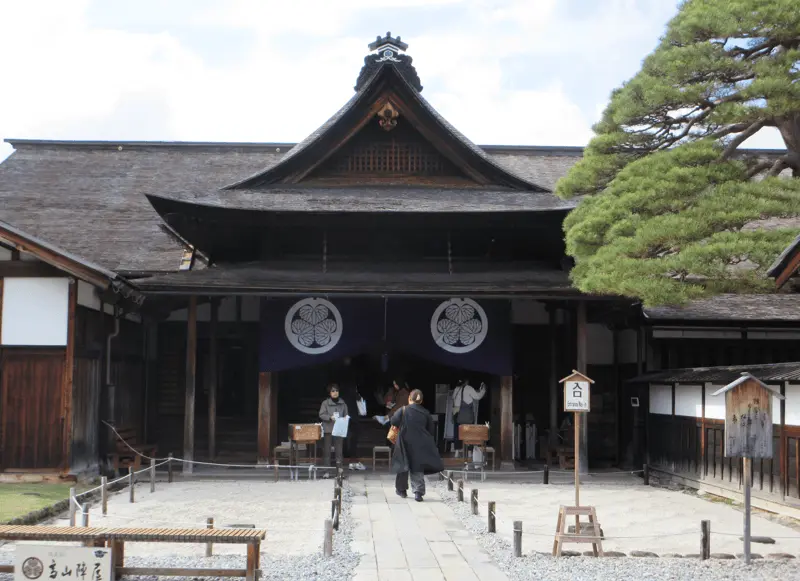
Takayama Jinya holds a unique and distinguished place in Japan’s architectural and administrative history.
It is the only remaining Edo-period government office in the entire country — a rare survivor of a system that once governed villages, towns, and mountain regions across Japan.
While Sanmachi Suji represents the merchant life of Takayama,
Takayama Jinya represents its political and administrative power.
Together, they form two sides of the same historical world.
Standing at the southern edge of the old town, the Jinya complex blends seamlessly into Takayama’s wooden landscape. The building might appear simple from the outside — low, elegant, and unobtrusive — but stepping inside reveals a surprisingly expansive world of tatami rooms, formal offices, inner gardens, and archival warehouses.
The Jinya tells the story of how Takayama became a tenryō — a territory ruled directly by the Tokugawa shogunate, rather than a local lord.
This elevated status meant that the town was strategically and economically important.
The surrounding forests provided high-quality timber, and the region’s craftsmen were in high demand for national projects.
Walking through Takayama Jinya today, you can still feel:
the quiet authority of wide tatami chambers
the minimal but intentional architecture of the Edo period
the lingering sense of order and discipline
the craftsmanship of beams, doors, and paper screens
the calm of the inner gardens
and the weight of bureaucratic records kept in the historic rice storehouse
It is a place where history remains alive not through big performances but through quiet, deliberate spaces.
Visitors often describe the experience as “peaceful, atmospheric, and unexpectedly moving.”
2. History & Architecture
A Center of Government in the Mountains
Takayama Jinya began as a local administrative office during the 17th century.
In 1692, when the Tokugawa shogunate placed the region under its direct control, the Jinya became the headquarters for national governance in the Hida area.
From here, officials oversaw:
tax collection
timber management
regional trade
inspections
and administration of villages
Because Hida was known for exceptional craftsmen, carpenters, and stonemasons, the shogunate cared deeply about maintaining stability here.
Thus, the Jinya was not just an office: it was the nerve center of the region.
Architectural Features
Takayama Jinya does not resemble a fortress or castle.
Its design reflects administration, not war:
wide tatami rooms for meetings
long corridors for movement
reception rooms of varying formality
carefully arranged gardens
sliding doors that conceal or reveal authority
connected offices designed for efficient work
The complex combines both formal spaces, where officials received important guests, and practical spaces, where clerks and administrators worked daily.
One of the most impressive architectural elements is the Oku-no-Shoin, a refined reception hall with an elegant view of the garden. Its proportions, wooden pillars, and sweep of tatami create an atmosphere of understated power.
The Rice Storehouse
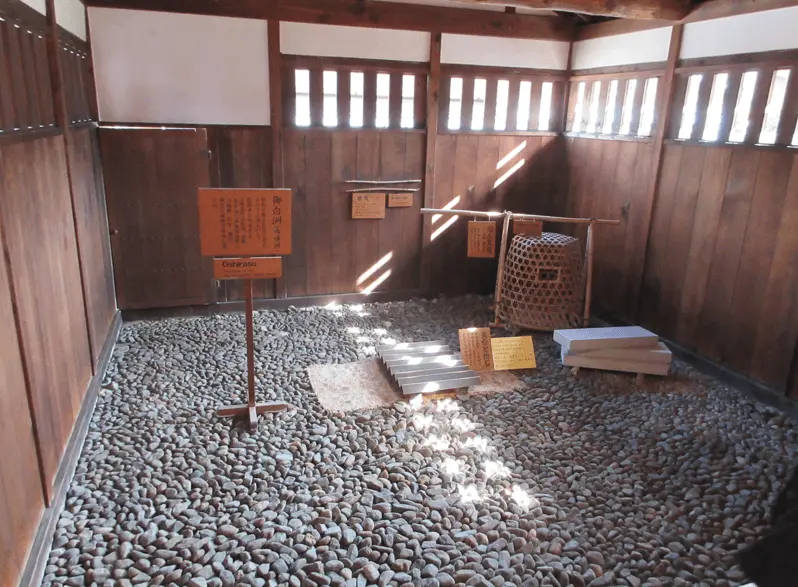
Perhaps the most iconic feature is the large komegura — the rice storehouse built in 1605, making it one of the oldest surviving government warehouses in Japan.
This storehouse:
held rice taken as tax from villages
preserved official documents
stored materials essential for governance
Today, its earthen walls and heavy beams remain intact.
Inside, exhibitions display tools, archival materials, and preserved objects from the administrative era.
3. Walking Through the Complex – Rooms & Spaces
Takayama Jinya is larger than it first appears.
The moment you step inside, the complex opens into a quiet world of corridors, tatami rooms, and gardens — each space revealing a different function of the Edo government.
Entrance & Outer Rooms
After removing your shoes, you enter the outer rooms where:
lower-ranking officials worked
documents were reviewed
clerks processed village reports
The atmosphere here is simple and functional.
The tatami rooms are modest in size, with minimal decoration — reminders that administration required precision rather than luxury.
Reception Rooms
Moving deeper into the complex, you encounter formal reception rooms.
These rooms are wider, with carefully aligned tatami mats and higher-quality woodwork.
They were used for:
receiving village leaders
hosting important guests
conducting formal inspections
settling disputes
Sliding doors open onto gardens, allowing natural light to soften the atmosphere.
Even in its administrative role, the building reflects the Japanese ideal of beauty woven subtly into everyday life.
Offices & Workspaces
These smaller rooms give visitors insight into how the bureaucracy functioned:
bundles of documents
wooden abacuses
old inkstones and brushes
diagrams and village maps
While recreated for display, they are based on historical records and old inventories.
The sense of order — and the sheer volume of paperwork — conveys how carefully the region was managed.
Garden Views
Between the rooms are inner gardens designed with simplicity:
moss
stones
manicured shrubs
soft pathways
seasonal flowers
These spaces were not for leisure but for creating calm and focus.
Their presence reminds visitors that while the Jinya was a place of power, it was also deeply attuned to natural aesthetics.
The Magistrate’s Quarters
Further inside lies the living space of the daikan — the regional magistrate.
These rooms are more refined:
slightly raised alcoves
carefully selected tatami
painted sliding doors
better light and airflow
While still modest by today’s standards, they reflect the importance of the magistrate’s role and status.
4. The Role of Takayama Jinya in Edo Society
Takayama Jinya was not just an office building — it was the administrative heart of a region that played a vital role in the shogunate’s national strategy.
Direct Rule (Tenryō)
Under direct shogunate rule, the Jinya was responsible for tasks such as:
controlling valuable timber resources
supervising carpenters assigned to major national projects
monitoring trade routes
collecting rice and taxes
maintaining law and order
Because Hida craftsmen were famous throughout Japan, the region’s output was crucial for temples, castles, and government projects.
Justice & Mediation
The Jinya served as a local court where disputes were settled:
land disagreements
village conflicts
trade issues
tax appeals
Officials had to balance authority with fairness to maintain stability in mountainous communities.
Economic Management
Rice taxes stored in the komegura were essential for:
regional budgeting
paying officials
supplying materials
supporting public works
The efficient management of the storehouse was considered one of the most important tasks in the region.
Cultural Influence
Takayama’s prosperity in the Edo era allowed merchants and craftsmen to flourish.
This administrative strength partly explains why:
Sanmachi Suji developed into a refined merchant district
traditional crafts like lacquerware thrived
festivals and cultural events became established
In short, the Jinya shaped the identity of Takayama as both a political and cultural hub.
5. Seasonal Atmosphere
Takayama Jinya changes mood with each season.
Spring – Gentle & Refreshing
In spring, the garden awakens:
fresh green moss
soft breezes flowing through sliding doors
sunlight filtering through newly sprouting trees
It feels clean and hopeful — perfect for slow walking.
Summer – Deep Shade & Cool Interiors
Thick wooden beams and wide eaves create cooler indoor temperatures.
The sound of cicadas outside contrasts with the quiet tatami rooms, amplifying the building’s calm.
Autumn – Golden Light & Crisp Air
Autumn brings warm light that accentuates textures of wood and tatami.
The small garden becomes especially photogenic with subtle color changes.
Winter – Quiet Snowfall
Snow on the rooftops and gardens creates a peaceful, almost meditative atmosphere.
Visitors hear:
soft footsteps
sliding doors opening
the muffled stillness unique to mountain towns
Takayama Jinya in winter feels like stepping inside a silent historical painting.
6. Access & Suggested Visit Plan
Location
Takayama Jinya sits just south of the old town, about:
10 minutes on foot from Takayama Station
a few minutes from Sanmachi Suji
Its central location makes it easy to combine with nearby spots.
Recommended Time of Day
Morning: calm and gentle light
Midday: busier but bright
Late afternoon: warm tones for photography
Suggested Duration
Plan about 45–60 minutes, longer if:
you read displays carefully
you enjoy architecture
you photograph interiors and gardens
The Jinya can comfortably fit into any Takayama itinerary, especially when paired with Sanmachi Suji before or after.
7. Traveler Tips & Etiquette
Shoes off: Floors are delicate; follow staff instructions carefully.
Photography: Allowed in many areas, but avoid flash and respect signs.
Noise: Keep voices low; sound travels easily through open rooms.
Barriers: Some rooms are view-only; do not cross ropes or steps.
Seasonal clothing:
Winter can be cold inside.
Summer can be warm; drink water beforehand.
Takayama Jinya is both a museum and a historic site.
Respecting the space helps preserve its unique atmosphere.
8. In Summary – Why Takayama Jinya Is #2
Takayama Jinya is a rare place where administrative history becomes a living, tangible experience.
Its quiet rooms, polished wooden corridors, and centuries-old rice storehouse show a world of order, structure, and regional pride.
It stands at #2 because:
it is nationally unique
it represents Takayama’s political identity
its architecture is harmonious and refined
it complements Sanmachi Suji perfectly
it offers a peaceful, contemplative experience for travelers
For your Takayama area page, this article forms the “historic authority” pillar — balancing the merchant culture of Sanmachi Suji and the natural charm of the riverside and craft areas.
© 2024 Kanazawa Experience. Affiliate Links