Kanazawa Experience
The Kuri of Myōzenji Temple – Where Faith and Daily Life Meet
1. About Myōzenji Kuri
Next to the grand thatched main hall of Myōzenji Temple stands a quieter, equally remarkable structure: the kuri, or temple residence.
While most visitors come to Shirakawa-go to see farmhouses, few realize that this humble temple building represents a one-of-a-kind treasure in Japan — the only remaining thatched-roof Buddhist priest’s residence built in the gassho-zukuri style.
The kuri once served as the home and workplace of the temple’s head priest, a space where spiritual life and daily living coexisted seamlessly. Meals were prepared by the hearth, visitors were received in tatami rooms, and the soft ring of the temple bell marked the passing of each day.
Today, the building stands as a museum of faith and village life, preserving the artifacts and atmosphere of a time when Buddhism in Shirakawa-go was not a distant ideal, but a living practice woven into every household.
2. History & Cultural Role
The Myōzenji Kuri was constructed in the late Edo period (around 1817), during a time when the Shirakawa-go valley was flourishing through silk cultivation and mountain trade. The temple, affiliated with the Jōdo Shinshū sect, was already a central gathering point for the community, but it needed a permanent residence for its priest and a facility for education, hospitality, and administration.
Unlike urban temples, which often separated sacred and secular life, Myōzenji’s priests lived among the people. The kuri’s construction symbolized this closeness — faith rooted in daily existence, not removed from it.
The design reflected both religious symbolism and practical adaptation. Built with steep thatched slopes to endure snow, its roof resembled the “praying hands” that define gassho-zukuri. Beneath that roof, villagers came to discuss irrigation, exchange seeds, and even share tea with the priest.
For more than two centuries, the kuri has stood through earthquakes, blizzards, and war, surviving as a rare fusion of Buddhism and vernacular architecture. Today, it remains an essential witness to how mountain faith communities thrived through humility, cooperation, and skill.
3. Architecture & Design Features
The architecture of the Kuri reveals both elegance and endurance.
Built entirely from local cedar and cypress, the structure rises nearly 17 meters high, with its thatched roof forming a steep 60-degree angle — designed to shed the region’s heavy snowfalls efficiently.
The roof is made of thick layers of pampas grass (susuki), bundled and tied with rope rather than fixed with nails. This allows the structure to flex slightly in wind or snow, preserving stability over centuries. The roof’s overhang protects the mud walls and wooden beams from moisture, while the attic beneath serves as vital insulation.
Inside, the timber framework is astonishingly intricate: massive beams crisscross each other like ribs, bound tightly with straw rope. The craftsmanship is purely human — no metal fasteners, no industrial tools. The entire structure was assembled through community effort, using wisdom refined over generations.
The layout reflects temple life:
The ground floor contained the living quarters and kitchen, centered around a hearth (irori).
The second floor held storage rooms and silkworm racks, supporting both sustenance and income.
The attic was used to store grains, religious scrolls, and ritual implements, kept warm and dry by the constant breath of smoke rising from below.
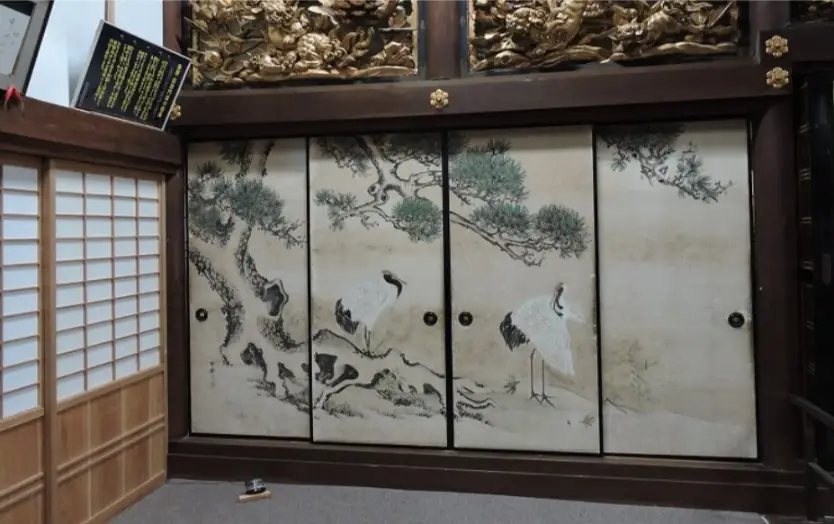
Even today, visitors can see soot-darkened beams, bamboo ceilings, and sliding shoji screens glowing softly in filtered light. Every detail tells a story of coexistence — between human hands, nature’s challenges, and spiritual calm.
4. The Museum Experience
Today, the Myōzenji Kuri Museum offers travelers a rare chance to experience life in a 19th-century temple residence — not through digital displays, but through atmosphere and authenticity.
The rooms are dimly lit by natural light, carrying the smell of cedar, smoke, and time. Exhibits are minimal but meaningful:
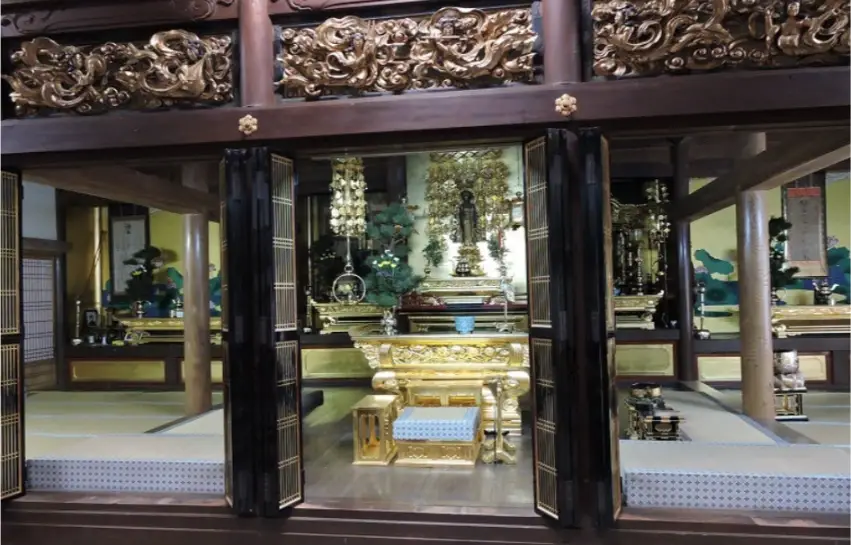
Buddhist ritual tools used in ceremonies — bells, offering bowls, and scrolls handwritten by temple priests.
Silkworm trays and wooden reeling tools, showing how the temple, like the villagers, relied on silk as an economic foundation.
Everyday objects — cast-iron kettles, ladles, sandals, and rice barrels — each worn by decades of use.
Historical manuscripts documenting the village’s relationship with the temple, including registers of births, marriages, and memorials.
Unlike modern museums, the Kuri invites stillness. There are no glass cases or bright signs — just the echo of your footsteps on aged floorboards. The silence itself becomes the exhibit.
You might see an elderly caretaker tending the hearth or adjusting a hanging kettle over the coals. This simple act — keeping a fire alive — perfectly symbolizes the temple’s mission: to preserve not only artifacts, but the warmth of continuity.
5. Preservation & Community Effort
The continued existence of the Myōzenji Kuri is an achievement of collective care.
Maintaining a thatched-roof structure in Japan’s snow country requires immense labor. Every 30–40 years, the entire roof must be replaced — a task involving tens of thousands of bundles of pampas grass and the coordinated work of dozens of villagers.
This process, known as kaya-okoshi, is done entirely by hand. Local carpenters lead the effort, while volunteers of all ages join to help. The event becomes both work and celebration — lunch shared on the temple grounds, laughter echoing as straw is lifted to the roof, and elders guiding the younger generation with quiet authority.
The yui spirit — Shirakawa-go’s tradition of mutual aid — remains alive in these moments. It’s the same cooperative ethos that keeps the village functioning through winter storms and agricultural cycles. In this sense, the Kuri is not merely preserved by the community; it helps preserve the community itself.
Financially, the temple receives modest support from donations and entry fees, but the true wealth lies in goodwill. The villagers’ pride ensures that each generation learns both the practical and spiritual lessons of their ancestors: that shared effort builds resilience, and faith is found not in monuments, but in action.
6. Access & Visiting Information
The Myōzenji Kuri is located beside Myōzenji Temple, near the southern end of Ogimachi Village in Shirakawa-go. It’s easily accessible and a must-see stop on any walking route through the village.
Walking access: From the main Deai Bridge parking lot, cross into the village and follow signs to “Myōzenji.” The walk takes about 10 minutes, through quiet lanes lined with thatched roofs and mountain views.
Opening hours: 9:00 AM – 5:00 PM (may close earlier in winter)
Admission: Adults 300 yen / Children 150 yen (includes entry to both the temple and Kuri Museum)
Closed: During heavy snowfall or roof maintenance periods
Inside, English-language pamphlets and small informational panels explain the exhibits. Staff — often local residents — are happy to answer questions about the architecture and history.
Facilities include restrooms near the entrance, a small rest area, and vending machines nearby. In winter, warm tea is sometimes offered inside the Kuri for travelers who linger in the cold.
The site is fully walkable, though visitors should wear shoes that can handle uneven wooden floors and slippery snow. Photography without flash is permitted, and respectful quiet is encouraged.
(See also → Access from Kanazawa / Private Tours & Transfers)
7. Traveler Tips & Seasonal Highlights
To experience the Kuri at its best, timing and mindset matter more than weather.
Morning visits (9:00–10:00 AM): Soft light filters through the paper screens, illuminating the wooden beams in warm hues.
Late afternoon (around 4:00 PM): The low sun outside creates a golden glow that fills the interior — perfect for photography.
Winter: Snow piles high on the roof, turning the building into a living snow sculpture. Inside, the warmth of the hearth feels magical.
Autumn: Red and orange maples surround the temple grounds, and the crisp air accentuates the scent of cedar and smoke.
Summer: The thick thatch provides natural cooling — step inside and feel the temperature drop instantly.
When visiting, remember:
Remove your shoes before entering.
Avoid flash photography.
Sit quietly for a few moments by the hearth — this is how villagers once meditated without calling it meditation.
If you visit both the temple and Kuri together, plan at least 40–50 minutes to walk through slowly. The two buildings complement each other perfectly: one representing spiritual elevation, the other, spiritual grounding.
(See also → Tips & Manners / Staying Overnight)
8. In Summary
The Myōzenji Kuri is one of Shirakawa-go’s most precious cultural gems — not just for its architecture, but for what it represents.
It stands at the meeting point between faith and daily life, craft and compassion, solitude and community.
Every beam, rope, and straw bundle embodies the harmony that defines this mountain valley. The Kuri reminds visitors that religion here was never about grandeur or hierarchy; it was about gratitude — for warmth, for food, for neighbors, for each moment of shared effort.
To sit within its walls is to feel the pulse of a living history — slow, gentle, and enduring. The sound of the hearth, the scent of thatch, the creak of the floorboards — all whisper the same lesson: beauty is born from care.
In the heart of Shirakawa-go, where snow and silence shape the rhythm of life, the Myōzenji Kuri continues to glow quietly — a house of peace built not just for monks, but for everyone who seeks stillness.
© 2024 Kanazawa Experience. Affiliate Links