Kanazawa Experience
Myōzenji Temple – The Spiritual Heart of Shirakawa-go
1. About Myōzenji Temple
In a village celebrated for its traditional farmhouses, Myōzenji Temple stands apart as a rare and sacred landmark — a Buddhist temple built in the same gassho-zukuri style as the homes that surround it.
Located near the southern entrance of Shirakawa-go’s Ogimachi Village, this temple represents the spiritual and cultural center of the community, embodying both faith and craftsmanship passed down through generations.
Unlike the grand temples of Kyoto or Nara, Myōzenji feels humble and human. Its thatched roof, towering nearly 18 meters high, blends perfectly with the surrounding landscape of mountains and rice fields. Step through its wooden gate, and you’ll find a quiet courtyard where smoke from the hearth drifts gently upward, mingling with the scent of cedar and incense.
Myōzenji belongs to the Jōdo Shinshū (True Pure Land) sect of Buddhism, which emphasizes gratitude and living in harmony with others. For centuries, this temple has served as a gathering place not only for religious ceremonies but also for community meetings, weddings, and seasonal festivals. In Shirakawa-go, faith and daily life are inseparable — and this temple is where those worlds meet.
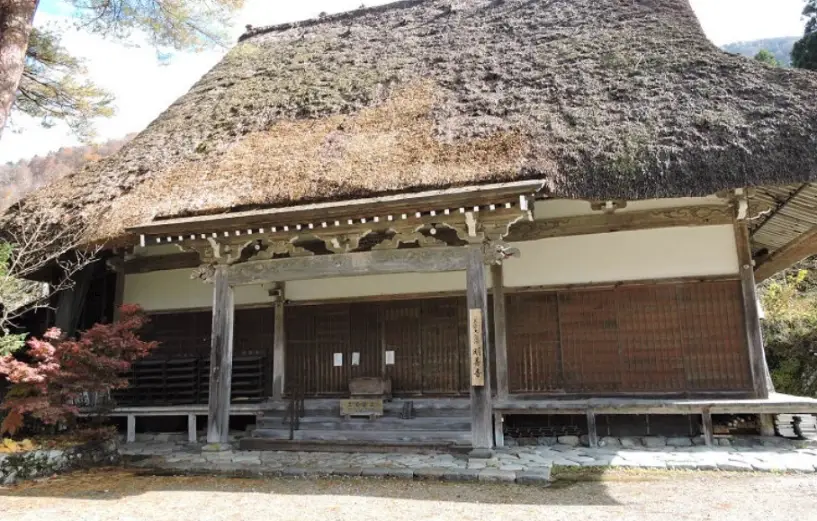
The building you see today dates back to the early 19th century, constructed by local carpenters using the same techniques as the village homes. Its massive thatched roof is the largest among religious structures in the area, and inside you’ll find a world of wooden artistry, handmade furnishings, and quiet devotion.
2. Historical Background & Cultural Role
The origins of Myōzenji Temple trace back more than 250 years. It was established during the Edo period, when Buddhist temples served not only as centers of faith but also as the administrative and social backbone of rural communities. In an isolated mountain valley like Shirakawa-go, temples were essential — they kept records, mediated disputes, taught children to read, and preserved moral order.
The temple was founded by followers of Shinran Shōnin, the monk who established the Jōdo Shinshū sect in the 13th century. His teaching emphasized the idea of nembutsu — reciting the name of Amida Buddha with a grateful heart. For farmers in these harsh mountain regions, the message of humility and shared compassion resonated deeply.
During its long history, Myōzenji Temple became more than a place of worship; it became a symbol of unity for the people of Shirakawa-go. The temple’s spacious hall often hosted important discussions among village elders, especially when managing irrigation, forestry, or communal labor. In this way, Buddhism in Shirakawa-go was not an abstract philosophy — it was woven into the rhythms of work and life.
In 1850, the temple underwent a major reconstruction, resulting in the magnificent gassho-zukuri hondō (main hall) we see today. Local carpenters — the same artisans who built the great farmhouses — used no nails, relying instead on wooden joinery and rope bindings. The result is a structure that embodies both faith and functional beauty.
Even during the Meiji era, when government policies sought to separate Shinto and Buddhism, the villagers continued to protect Myōzenji Temple, understanding it as a vital thread in their cultural fabric. That protection continues to this day — the temple remains active, with priests conducting ceremonies and villagers gathering for festivals such as Obon and Hōonkō, which honor ancestors and express gratitude for life.
3. Architecture & Artistic Details
The architecture of Myōzenji Temple is a masterpiece of mountain craftsmanship.
At first glance, it looks like another farmhouse, but step closer and the differences reveal themselves — larger scale, finer materials, and a sense of quiet majesty that only sacred spaces possess.
The main hall (hondō) is constructed in the gassho-zukuri style, its steep thatched roof rising dramatically toward the sky. The roof’s shape, resembling hands pressed together in prayer, carries profound symbolism: it represents gratitude, harmony, and the human link between heaven and earth.
Inside, the altar glows softly with golden light, its simplicity contrasting with the natural texture of the wood. The beams above your head, darkened by decades of smoke, arch like ribs supporting a living body. Every corner reveals subtle craftsmanship — carved lotus patterns, wooden joinery polished smooth by time, and paper screens that filter sunlight into a warm amber glow.
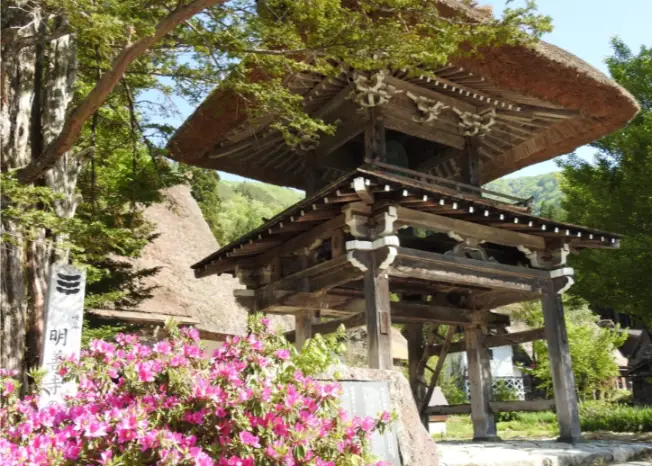
One of the temple’s most remarkable features is the bell tower gate, also thatched in the same traditional style. It is said that the sound of its bronze bell, when struck on calm mornings, echoes through the valley and reminds residents to live each day with gratitude.
Unlike most temples, Myōzenji also includes a thatched-roof priest’s residence (kuri) adjacent to the main hall. This structure, equally impressive in scale and preservation, now serves as a small museum where visitors can view artifacts related to the temple and village life — old farming tools, scrolls, Buddhist manuscripts, and silk-weaving implements used by the monks and villagers alike.
The blend of sacred and practical architecture shows how religion in Shirakawa-go was never separate from daily existence. Just as the villagers built their homes to endure the snow, they built their temple to sustain the spirit.
4. The Temple Grounds & Atmosphere
Myōzenji Temple may not be large, but its atmosphere is profound. The moment you step through the wooden gate, the noise of the outside world fades away. The path leading to the main hall is lined with moss-covered stones, and the scent of pine drifts on the breeze. In spring, cherry blossoms frame the temple in soft pink; in autumn, fiery maples set the grounds ablaze with color.
The grounds are meticulously maintained by local volunteers, many of whom are descendants of the same families who built the temple centuries ago. Their work is an act of devotion — sweeping fallen leaves, tending the garden, repairing fences — all done quietly, without ceremony.
To the left of the main hall stands a small cemetery, shaded by tall cedars. Here rest generations of villagers who lived and died in Shirakawa-go, their gravestones carved with simple, unadorned characters. Visiting in the early morning, when mist still lingers among the trees, you can feel the deep continuity of life and death, work and prayer, that defines this place.
In front of the temple, a wooden veranda overlooks the rice fields and mountains beyond. Sitting here, listening to the wind and distant river, one understands why Buddhism flourished in these valleys: not as ritual, but as a way of seeing the world. The villagers didn’t need grand statues or gilded halls — they found enlightenment in the daily act of living with care.
When you ring the temple bell, its sound expands slowly across the landscape — deep, clear, and resonant. It’s said that those who listen closely can hear their own thoughts reflected back. That is the magic of Myōzenji Temple: it doesn’t ask you to believe, only to pause.
(See also → History & World Heritage Background)
5. Preservation & Local Involvement
The preservation of Myōzenji Temple is a story of devotion — not only to religion, but to heritage, craftsmanship, and community identity. Unlike temples in urban Japan that rely on large religious organizations or state support, Myōzenji survives thanks to the dedication of the local people.
For generations, villagers have taken turns maintaining the thatched roof and repairing the wooden structures. The temple’s caretakers still practice the yui spirit — the same tradition of mutual cooperation that built Shirakawa-go’s farmhouses. When the roof needs renewal, everyone contributes, from elders who tie ropes to children who carry grass bundles. The process is labor-intensive, but it is also celebratory, filled with laughter, songs, and shared meals.
This communal care extends beyond the physical building. Each year, villagers organize festivals and memorial services on the temple grounds. During Obon in August, families return from cities to honor their ancestors. Lanterns line the pathways, their gentle light reflecting in the rice paddies, and the air hums with the sound of Buddhist chants mixed with the laughter of children. In winter, the temple’s snow-covered roof becomes a symbol of endurance and peace — a beacon of warmth in the frozen valley.
Myōzenji also plays a quiet but vital role in cultural preservation and education. The small museum adjacent to the main hall houses documents, farming tools, and everyday artifacts, allowing visitors to understand how faith shaped the rhythm of mountain life. Local guides, many of them lifelong residents, explain how Buddhism here was never separate from survival: it taught gratitude for food, respect for nature, and acceptance of impermanence — lessons as relevant today as they were centuries ago.
In recent years, environmental changes and depopulation have challenged the community. Heavy snowfalls and aging roofs require increasingly complex maintenance, while younger generations often move to cities. Yet Myōzenji continues to stand because it is more than a building — it is the village’s collective heart. As long as people still gather here to pray, to celebrate, and to remember, the temple will remain alive.
6. Access & Facilities
Myōzenji Temple is one of the most accessible sites in Shirakawa-go, located near the southern entrance of Ogimachi Village. Whether you arrive by bus, car, or on foot, it’s an easy and rewarding visit.
Walking access: From the main parking lot near the Deai Bridge, walk north into the village and follow signs marked “Myōzenji.” It’s about a 10-minute stroll along charming village paths surrounded by thatched houses and rice fields.
Opening hours: 9:00 AM – 5:00 PM (hours may vary slightly by season)
Admission: Adults 300 yen / Children 150 yen
Closed: Occasionally during deep winter snow or maintenance
By car or tour: Private vehicles must park in the main lot outside the village. From there, it’s a short walk. Many private car tours from Kanazawa or Takayama include Myōzenji as a stop, often after visiting the Ogimachi Viewpoint or the Wada and Kanda Houses.
Facilities:
-
A small ticket office and souvenir corner at the entrance sell handmade amulets, incense, and postcards.
-
The adjoining museum displays historical items such as Buddhist scrolls, lacquerware, and local tools used by monks and villagers.
-
Restrooms are available near the entrance, and benches line the garden for quiet rest.
-
The bell tower and courtyard are open to visitors year-round, though access to the inner altar may be restricted during religious ceremonies.
Accessibility: The grounds are mostly flat, though the path leading to the main hall includes a few stone steps. Winter visitors should wear non-slip boots, as the snow can make surfaces slick.
One of the best times to visit is early morning, when the sun rises behind the mountains and the temple glows in golden light. The calm atmosphere allows visitors to hear the soft ring of the bell echoing across the valley — a sound said to bring good fortune to those who listen mindfully.
(See also → Access from Kanazawa / Private Tours & Transfers)
7. Traveler Tips & Etiquette
Visiting a temple in Japan is not just sightseeing — it’s a cultural encounter. Myōzenji invites you to participate in its peace, not just observe it. To ensure a respectful and rewarding experience, keep these gentle guidelines in mind:
-
Dress modestly: Casual clothes are fine, but avoid overly revealing attire. Remember, this is an active place of worship.
-
Remove shoes: Before entering the main hall or museum, please take off your shoes and use the provided slippers.
-
Quiet appreciation: Maintain a soft voice, especially inside the temple. Even footsteps carry in the silence of wooden floors.
-
No flash photography: Photos are welcome, but flash and tripods are discouraged. The temple’s natural lighting creates its own beauty.
-
Offer respect: Many visitors choose to bow slightly before the altar or ring the bell once before leaving — a simple act of gratitude that transcends religion.
-
Be mindful of ceremonies: If a service or prayer session is taking place, observe quietly or wait until it finishes before entering.
When to visit:
Each season offers its own mood.
-
Spring: Cherry blossoms frame the temple, symbolizing rebirth.
-
Summer: Lush green fields surround the temple, and festivals fill the air with chants and drums.
-
Autumn: The grounds glow red and gold, making this one of the best photo spots in Shirakawa-go.
-
Winter: The temple blanketed in snow feels almost timeless — a perfect scene of purity and stillness.
If you stay overnight in the village, try walking to the temple at dawn or dusk. The path is quiet, and the sound of your footsteps on the snow or gravel will feel like part of the landscape itself. Myōzenji rewards those who slow down — those who are willing to listen.
(See also → Tips & Manners / Staying Overnight)
8. In Summary
The Myōzenji Temple is far more than a religious site — it is the spiritual and emotional anchor of Shirakawa-go. Amid a village renowned for its architectural beauty, this temple reminds us that true heritage is not just about what we build, but how we live.
Its thatched roof, built by villagers’ hands; its wooden beams, polished by smoke and time; its bell, ringing across the fields — all express a quiet gratitude that has defined life in this valley for centuries. The temple doesn’t dazzle with grandeur; it moves you with sincerity.
Visiting Myōzenji is a moment of pause in the journey through Japan. You come for the view, perhaps, but you leave with something subtler — an understanding that beauty and faith can coexist in simplicity. It’s a place where the human and natural worlds meet in perfect balance.
As you walk away, you might glance back one last time. The mountains rise like silent guardians behind the temple, and the faint sound of the bell follows you down the path. In that moment, you realize that Myōzenji’s true power is not what you see, but what you feel — a sense of peace that stays long after the visit ends.
© 2024 Kanazawa Experience. Affiliate Links