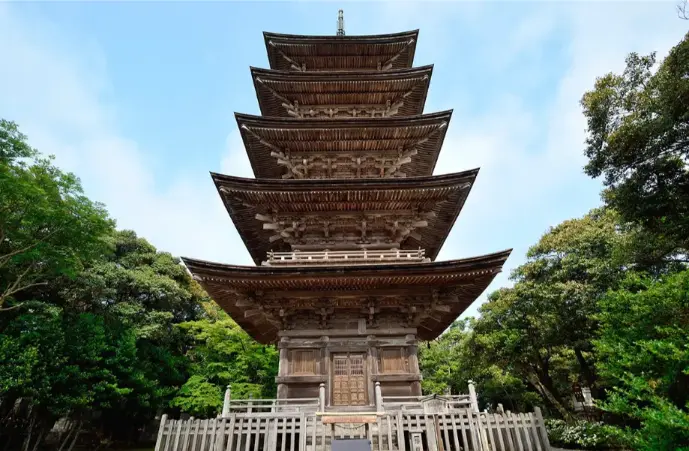
While Kanazawa boasts the manicured beauty of Kenrokuen Garden, a short drive north into the Noto Peninsula reveals one of the Hokuriku region’s most impressive, yet often overlooked, spiritual sites: Myojo-ji Temple.
Located in Hakui City, just minutes from the famous Chirihama Beach driving route, this temple offers a profound silence and architectural beauty that rivals anything found in Kyoto. Famous for its breathtaking five-story pagoda, Myojo-ji is currently aiming for designation as a National Treasure.
For drivers exploring the Noto Peninsula, this is an essential stop. It offers not only a glimpse into deep history but also a serene escape from the crowds. Here is your comprehensive guide to exploring this architectural masterpiece.
1. The Five-Story Pagoda: A Masterpiece of Edo Architecture
The undisputed highlight of Myojo-ji is its magnificent Five-Story Pagoda (Goju-no-to). Standing over 34 meters tall, it represents the pinnacle of wooden architecture in the Hokuriku region.
Built in 1618 by master carpenters from the Kaga Domain, the pagoda is a designated Important Cultural Property. What makes it truly special is its construction style. The roofs become smaller as they go up in a precise ratio, creating a silhouette that is considered one of the most beautiful in Japan. The weathering of the wood over 400 years has given it a profound, silver-grey dignity that contrasts beautifully with the surrounding pine trees.
Unlike crowded tourist spots where you are pushed along by throngs of people, here you can stand directly beneath the pagoda in almost complete silence, admiring the intricate woodwork of the eaves.
Our Pro’s Tip: The best photo angle is not from the front, but from the slightly elevated garden path behind the main hall. From there, you can capture the pagoda framed by cherry blossoms in spring or vibrant maple leaves in autumn.
2. The Powerful Legacy of the Maeda Clan
Founded in 1294, Myojo-ji has a deep and inseparable connection to the Maeda Clan, the powerful feudal lords who ruled the Kaga Domain (modern-day Ishikawa and Toyama).
For generations, the Maeda family supported this temple as a dedicated prayer site for the prosperity and safety of their domain. This patronage explains why a temple in such a quiet coastal location possesses such grand and majestic buildings.
In fact, ten of the temple’s buildings, including the Main Hall, the Bell Tower, and the Pagoda, are designated as Important Cultural Properties. As you walk through the grounds, look closely at the roof tiles and decorations; you will frequently see the “Plum Blossom” crest (Ume-bachi), the symbol of the Maeda family, signifying their deep influence here.
3. The Joju-en Garden: A Moment of Zen
Beyond the architecture, the temple grounds feature a beautiful strolling garden known as Joju-en.
Designed to harmonize with the natural landscape of the Noto Peninsula, the garden offers a different expression in every season. The layout utilizes the technique of “borrowed scenery,” making the surrounding hills feel like part of the garden itself.
Spring: Weeping cherry trees bloom against the backdrop of the pagoda.
Summer: The lush green moss and maple leaves provide a cooling visual escape.
Autumn: The grounds turn into a fiery canvas of reds and oranges.
Winter: The “Yukitsuri” (rope supports for trees) and snow-covered pagoda create an ink-wash painting come to life.
Visitors can enjoy a peaceful walk along the garden paths, listening to the wind in the trees and the distant sounds of nature. It is a perfect spot for mindfulness and meditation.
4. Driver’s Guide: Access and Parking Tips
One of the biggest advantages of visiting Myojo-ji is its accessibility for drivers.
Parking: The temple offers a free parking lot located immediately adjacent to the entrance (Sanmon Gate). Unlike the cramped parking situations in central Kanazawa, the lot here is spacious and easy to navigate, even for larger rental cars.
Road Conditions: The drive from Kanazawa via the Noto Satoyama Kaido (a toll-free expressway) is smooth and scenic, offering views of the Sea of Japan. The local roads leading from the highway interchange to the temple are paved and two lanes wide, making it a stress-free drive for international visitors.
Nearby Driving Spot: We highly recommend combining your visit with the Chirihama Nagisa Driveway, located just 15 minutes away by car. It is the only beach in Japan where you can legally drive a regular car on the sand. Visiting the spiritual pagoda and the open ocean on the same trip makes for an unforgettable Noto driving course.
5. Uniquely Noto: The “Kibune” Offering Hall
Myojo-ji is also unique for its connection to local beliefs. The temple grounds house the Sanju-banjin-do (Hall of the 30 Guardian Deities), which blends Buddhism with local protective spirits.
This reflects the history of the Noto Peninsula, where people lived close to the harsh nature of the sea and relied deeply on spiritual protection for safe voyages and good harvests. It is a place where you can feel the prayers of the local people that have accumulated over 700 years.
Conclusion
Myojo-ji Temple is more than just a historical site; it is a sanctuary of peace that has watched over the Noto Peninsula for centuries. The sight of the five-story pagoda rising above the trees is an image that embodies the resilience and beauty of this region.
Escape the city crowds, take the scenic drive along the coast, and find a moment of true serenity at Myojo-ji. It is a journey that rewards those who travel off the beaten path.
Visitor Information:
Location: Takidani-machi, Hakui City, Ishikawa Prefecture
Opening Hours: 8:00 – 17:00 (April to October), 8:00 – 16:30 (November to March)
Admission: Adults 500 JPY